
Dates: 03-06 March 2026
Place: Helsinki, Finland
The 2026 winter school is organised in collaboration with IQM Quantum Computers, Aalto University, Nordea, Nokia and Wolt.
Note: this page will be continuously updated until the Winter School.



See the overall 2026 EDISS Winter School programme here.
EDISS Intake 5 Student Research projects – Presentation, posters and videos
Will be presented on Thursday, 05.03.2026, from 10:00 to 12:45 at the Nokia Innovation Hub and Garage, Nokia Headquarters, Espoo. The research posters and videos will be provided just before the Winter School.
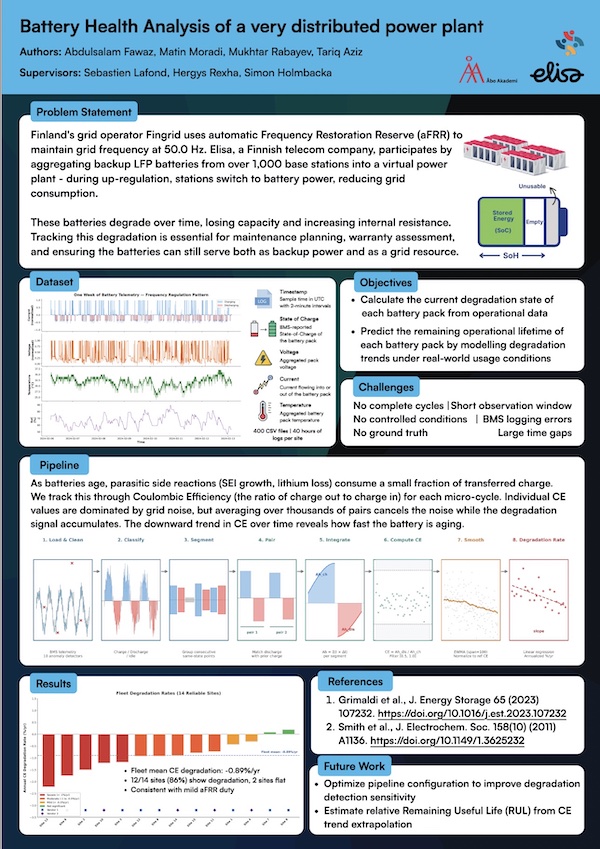
1 – Battery health analysis of very distributed Virtual Power Plant
Mukhtar Rabayev, Abdulsalam Fawaz Akolade, Tariq Aziz, Matin Moradi
Telecom battery fleets are no longer just backup systems. They are becoming critical energy assets, and in a Virtual Power Plant setup they can play a real role in the energy market by providing flexibility when the grid needs it. The problem is that built-in State of Health (SoH) counters, which are supposed to show battery condition, do not always reflect degradation accurately or early enough. So real degradation can be happening while the counter still looks flat, which delays maintenance decisions, increases the chance of unexpected failures, and puts risk on the energy that was promised to the market.
Watch the project video here: https://youtu.be/-1vKrqyLZSA
See more..
We are building an end-to-end, data-intensive pipeline that ingests telemetry, handles data quality issues, and segments operation into meaningful discharge cycles. On top of that pipeline, we estimate SoH using a physics-based approach: Coulomb counting with sign-aware integration over cycles, designed to be transparent and explainable. Using ~1.5 years of data with a sampling rate around 1–2 minutes, our current results already indicate early degradation signals on the order of ~1–3% for selected sites, even in cases where built-in SoH counters appear unchanged.
2 – Integrating Kolmogorov-Arnold Networks and Evolutionary Game Theory for Interpretable Cancer Dynamics and Biologically Plausible Equation Discovery
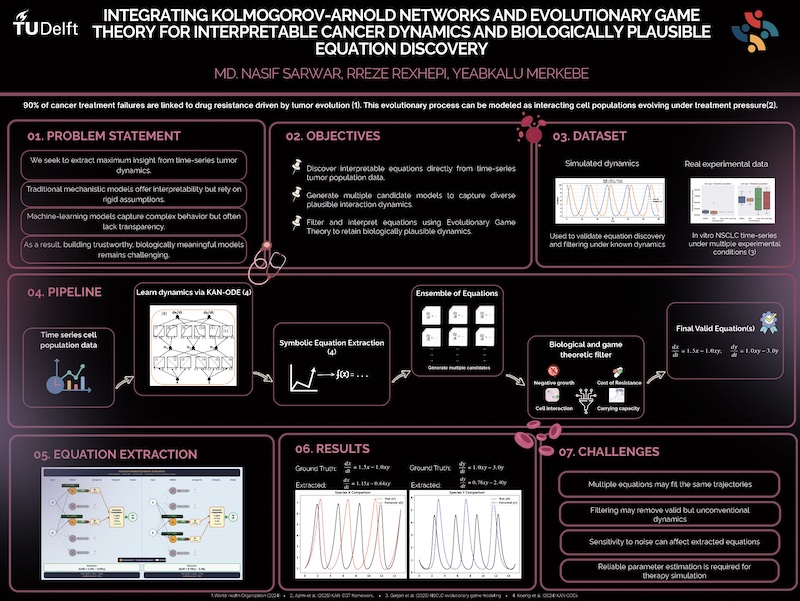
Md Nasif Sarwar, Rreze Rexhepi, Yeabkalu Merkebe
Modeling tumor population dynamics from time-series data is challenging because there is a tension between expressive models and interpretability. Classical mechanistic models are interpretable but often too restrictive to capture complex, nonlinear interactions, while modern machine learning models can fit the data well but typically act as black boxes, offering limited insight into underlying population interactions. This lack of interpretability makes it difficult to reason about competing dynamics, interaction mechanisms, and condition-dependent behavior in evolving tumor cell populations.
Watch the project video here: https://youtu.be/8cTHuz7VeFg
See more..
To address this, we develop a hybrid framework that combines Kolmogorov-Arnold Network–based ODE learning (KAN-ODEs) with Evolutionary Game Theory (EGT) to extract explicit dynamical equations from tumor population time-series data. Instead of identifying a single best-fitting model, we deliberately generate an ensemble of candidate equations, each capturing a distinct dynamical regime and interaction structure consistent with the same data. To avoid arbitrary or implausible models, we introduce theoretical filtering constraints based on biological feasibility (e.g., non-negative populations, bounded growth) and evolutionary game-theoretic consistency, retaining only equations that remain interpretable and grounded in theory.
We evaluate this approach using simulated population dynamics and in vitro Non-Small Cell Lung Cancer (NSCLC) time-series data, tracking sensitive and resistant tumor cell populations across multiple experimental conditions, including drug treatment, fibroblast co-culture, and varying initial mixtures. The outcome of this work is not a predictive product, but a research framework for theory-guided equation discovery, demonstrating how interpretable model ensembles can be extracted from complex biological time-series data to support mechanistic understanding and comparative analysis across conditions.
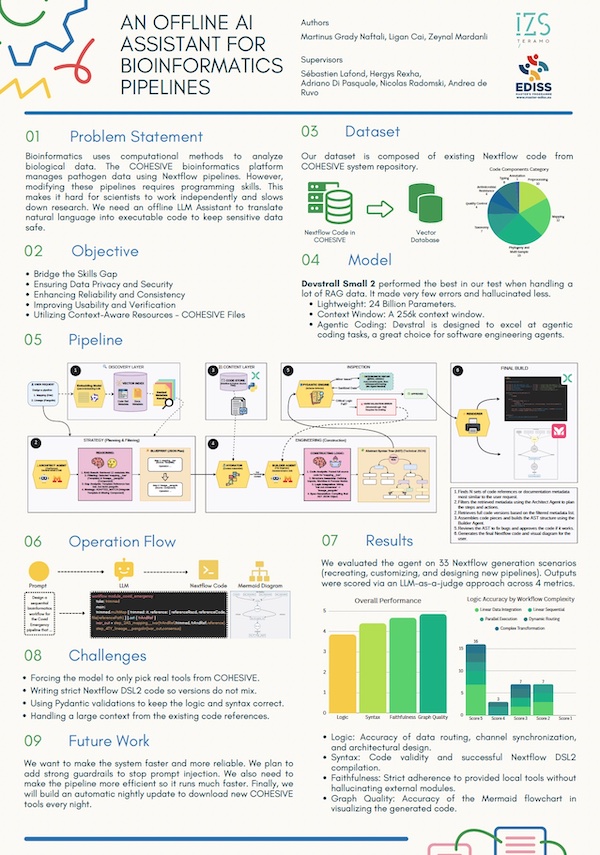
3 – An Offline AI Assistant for Bioinformatics Pipelines
Martinus Grady Naftali, Zeynal Mardanli, Ligan Cai
Imagine you are a biologist racing to stop a disease outbreak. You know exactly what questions to ask the data, but you do not speak the complex programming language needed to get the answers. If you use a standard AI from the internet, it is like handing your secret research notes to a stranger on the street. They might steal your ideas or give you bad advice that ruins the experiment. In high-stakes science, a “hallucination” or a data leak can be a disaster, so you cannot just trust a chatbot with your work.
Watch the project video here: https://youtu.be/zuzu08MqA9I
See more..
Our project solves this by building a secure, digital laboratory inside your own servers. Instead of a general chatbot, we created a private team of specialized agents that work 100% offline. You simply explain your scientific goal, and our “Architect” agent plans the workflow while the “Builder” agent assembles the exact code you need from your internal library. We use a smart system that combines Retrieval-Augmented Generation (RAG) with strict structural rules to ensure the code is error-free.
But we do not just give you text. We deliver the complete package. Our system automatically draws a clear visual map of your workflow using Mermaid diagrams so you can see the logic instantly. Then it writes the final, high-quality Nextflow code that is ready to run. You get the visual clarity of a diagram and the raw power of professional code, all generated safely behind your own firewalls.
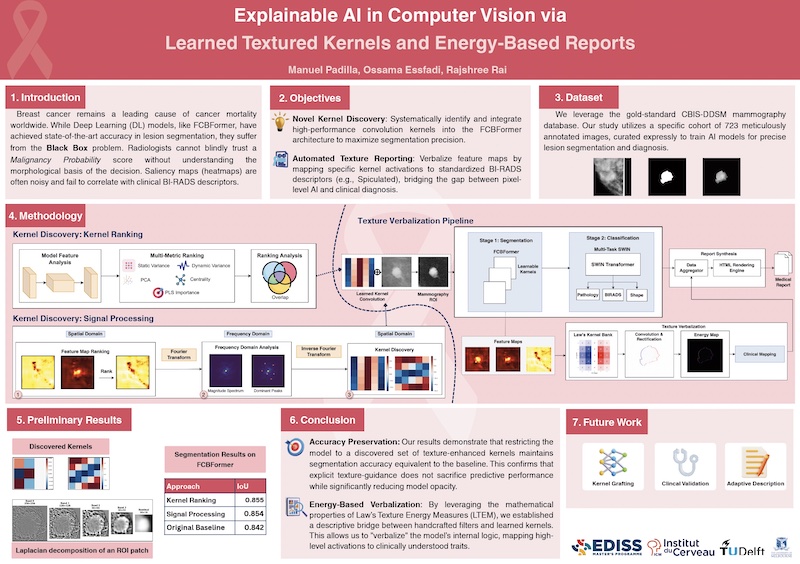
4 – From Black Box to Clinical Insight: Explainable AI in Computer Vision via Learned Textured Kernels and Energy-Based Reports
Ossama Essfadi, Manuel Padilla, Rajshree Rai.
Modern deep learning models achieve impressive performance in medical image segmentation and classification, but remain largely black boxes, limiting their adoption in safety-critical clinical settings. In this project, we propose a practical framework for explainable medical AI by extracting data-driven kernels from feature maps of deep models, effectively learning meaningful visual laws that reveal what the network attends to and how different patterns contribute to its decisions. Rather than treating explainability as a post-hoc visualization, we embed interpretability directly into the representation learning process.
Watch the project video here: https://youtu.be/uiwuUW3qWog
See more..
These learned kernels are used to preprocess and analyze medical images, producing textured representations that guide segmentation with FCBFormer and classification with a Swin-based model. We further introduce law masks and energy-based measures to quantify the contribution of each learned pattern, and generate an automated medical-style report that translates internal model reasoning into human-readable clinical insights. The result is not just accurate predictions, but transparent, auditable, and trustworthy AI for real-world medical decision support.
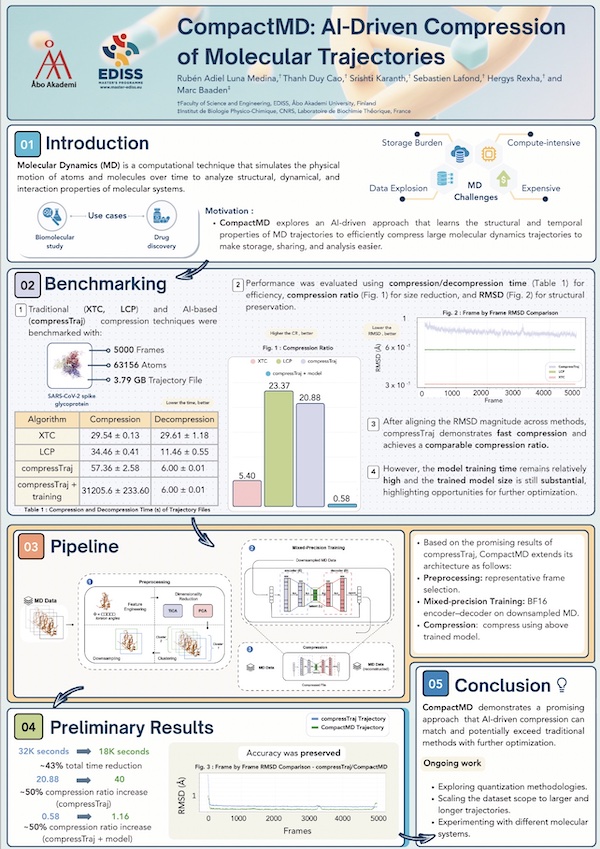
5 – CompactMD: AI-Driven Compression of Molecular Trajectories
Adiel Luna, Srishti Karanth, Thanh Duy Cao
Have you ever wondered how scientists design new drugs, study viruses, or understand the behavior of complex molecular systems? How can interactions that are far too small and too fast to observe be studied at all? One of the key tools enabling this is molecular dynamics (MD) trajectories, which models molecular systems atom by atom over millions of time steps.
Watch the project video here: https://youtu.be/CaV0sTwAYzA
See more..
But there is a catch. Modern MD simulations generate enormous volumes of data. A single run can produce terabytes of trajectory files that are difficult to store, painful to share, and increasingly expensive to analyze. As MD methods become more accurate and trajectories grow longer, data volume has quietly emerged as one of the biggest bottlenecks in computational molecular science.
CompactMD asks a simple but provocative question: why compress molecular data as if it were random numbers, when it follows physical rules? We benchmarked classical compression methods such as XTC and LCP against AI driven approaches like compressTraj, leading to a key observation that autoencoders do more than compress, they learn molecular motion. Building on this, we aim to exploit the fact that proteins revisit a limited set of conformational states by identifying and leveraging clusters within trajectory data. By detecting and exploiting these hidden clusters inside trajectory data, we are building structure aware compression that is faster, smaller, and smarter, demonstrating how AI can contribute by understanding the data, not just processing it. If you are curious what happens when machine learning meets molecular physics, this is a session you do not want to miss.
2026 Winter School program overview
Tuesday 03.03
11:30 – 12:50 Lunch at Hotel Arthur
13:00 – 14:50 2nd year presentations at Hotel Arthur
15:00 – 17:00 Technical presentations, AI & Quantum Computing.
- Quantum AI, Debayan Bhattacharya, Aalto University
- From Data to Qubits: Where AI Fits in Quantum Computing, Ashish Dahal, IQM Quantum Computers
18:00 – 21:30: Winter school opening dinner
Wednesday 04.03 @ Nordea
9:30-9:45 Nordea: Introduction and Welcoming Words
9:45-10:30 A Technical Journey Through AI Agent Protocols, Camille Van Hoffelen, Expert Data Scientist (Financial Crime Intelligence Investigations Analytics)
10:30-11:15 The role of Architecture in our evolving data landscape, Jesper Lind, Head of Data & Information Architecture at Nordea
11:15-12:00 AI Acceleration: Nordea’s strategy and direction for implementing AI, Juha Tuomi, Head of AI Strategy & Transformation at Nordea
12:00 – 13:00 Lunch @ Nordea Campus
13:00-13:45 Modern Data Analytics in Internal Audit, Andre Hellen, Internal Auditor (Group Internal Audit Data and Analytics) at Nordea
13:45-14:30 AWS Cloud Explained: From Concept to Implementation, Luciano Dolenc, Senior Data Engineer (Financial Crime Intelligence Investigations Analytics) at Nordea
14:30 – 15:00 Coffee and Networking
15:00 – 15:15 Nordea as an employer: Meet our Tech Recruiters
15:15-16:00 Alumni @ Nordea Talks
- Aarohi Garg
- Aanchal Upreti
- Nicolas Restrepo Torres
16:00-16:15 Conclusion & Reflections
17:30 – 19:30 Social activity – Prison Island Helsinki
Thursday 05.03 @ Nokia
9:30 – 9:45 Checking @ Nokia headquarters
10:00 – 12:00 EDISS year-1 DIEng. presentations
- Battery health analysis of very distributed Virtual Power Plant
- Integrating Kolmogorov-Arnold Networks and Evolutionary Game Theory for Interpretable Cancer Dynamics and Biologically Plausible Equation Discovery
- An Offline AI Assistant for Bioinformatics Pipelines
- From Black Box to Clinical Insight: Explainable AI in Computer Vision via Learned Textured Kernels and Energy-Based Reports
- CompactMD: AI-Driven Compression of Molecular Trajectories
12:00 – 12:45 EDISS year-1 DIEng. poster presentations
- Research topic fair: the above student team will present their project demonstrations and research poster.
12:45 – 13:30 Lunch @ Nokia headquarters
13:45 – 14:10 AIKON, AI-based solution for network control plane analysis, Oskari Kiili, Thesis worker @Nokia
14:10 – 14:30 Air Interface Intelligence: Where AI/ML Meets 6G Standardization, Muhammad Ikram Ashraf, Senior Staff Research
14:30 – 14:45 Coffee break
14:45 – 15:30 RAN R&D Data Platform to Enable Analytics and AI/ML at Scale, Shazam Kasher, System Architect (Data and ML)
Friday 06.03 @ Wolt & Alumni presentations
9:00 – 11:30 Presentation from Applied Science at Wolt
9:00 – 9:15 Mingle
9:15 – 9:30 Introduction of Wolt and its Applied Science team
9:30 – 9:50 EDISS Alumni Spotlight: My Wolt Internship Experience, Motunrayo Ibiyo
9:50 – 10:15 Finding My Path to Wolt: from International Student to Software Engineer, Nicolas Jovianto
10:15 – 10:20 Stretch your legs
10:20 11:00 ML in Product development: Value, Trade-offs, and Challenges, Kasimir Aula
10:45 – 11:30 Q&A session between EDISS students and the Applied Science team at Walt
11:30 – 12:30 Lunch at Wolt – Pizza and mingle
13:00 – 15:30 Alumni presentations
- 13:00 – 13:15 Let the Data Decide: A/B Testing, Melih Kurtaran
- 13:20 – 13:35 3D Animation Transfer with Video and Audio Cues, Muhammad Shaher Yar
- 13:40 – 13:55 Sensor Fusion odometry, Joaquin Caballero
- 14:00 – 14:15 The blood-brain Barrier: The Good, the Bad, and the Ugly of Getting Nanoparticles Across, Halidu Abdulai
14:15 – 14:25 Break
- 14:30 – 14:45 Exploring and analyzing Deep learning-based methods for digitized city footprint extraction from aerial images, Mira Budenova
- 14:50 – 15:05 SPNs: Learning Through Chaos, Sarosh Krishan
18:00 – 21:00 Closing dinner in Suomenlinna: Bastion Bistro